

An Introduction to The Intersection
Who I am, what I'm doing here, and why you should care (you probably shouldn't).

Who the hell are you?
Great question, friend. My name is not Peter X. Feldman (more on that in a moment), but names don’t really get to the heart of who people are anyway. So, in an effort to introduce you to who I am, even if I refuse to give you my actual name, here’s a bit of my life story.
The Early Years
I grew up essentially an only child (apologies to my half-brother and half-sister, but they lived on the east coast and weren’t involved much in my life) in northwest Montana (a small town five miles from the Canadian border called Eureka), where I was homeschooled by my father. He was a retired college professor, among many other things, who had spent his life studying government and the American system of government in particular. He believed wholeheartedly in classical education, and I read everything from Plato’s Republic to the Founders’ Federalist Papers long before most of my peers had even heard of them. Unsurprisingly, my family, and I by extension, was quite conservative. Although I didn’t grow up in the church, I was saved by the grace of God at 15 years old. I decided shortly thereafter that I wanted to pursue a pastoral ministry.
Undergraduate and Seminary
In the first step on my journey to ministry, I went off to study at a small liberal arts school two hours outside of Detroit called Hillsdale College. There, rather than studying theology or philosophy, I studied English. I loved stories, but more than that, I believed they taught powerful lessons about the human soul and its place in the universe. I anticipated learning most of my theology through seminary, and exploring man and all of his virtues and vices through a different medium struck me as more productive than stacking theology on top of more theology.
Of course, I didn’t devote my entire collegiate career to reading stories (just as much of it as possible). In preparation for seminary, I studied Attic Greek for two years (loved it) and spent a semester ‘learning’ Hebrew (beautiful language, awful class). These forays into language sparked a deep love of linguistics in general, and I wound up studying Old English, Middle English, and German to various degrees as well. (I also studied a bit of Latin in junior high and Spanish in high school.) I speak none of those languages well enough to use them in any meaningful sense (I studied them; I don’t know them), but I remain sincerely fascinated by how language is put together and how it grows and shifts over centuries of use.
I also took some courses touching on theology, including an Old Testament survey course and a course focused on Jonathan Edwards, one of America’s foremost theologians. Add to this a community of faithful believers deeply concerned with questions of doctrine, and my theology grew from a fledgling understanding of basic biblical tenets to a relatively robust orthodox Christianity with strong Calvinist components.
Politically and economically, and despite Hillsdale’s reputation as a bastion of conservative indoctrination, I was exposed to a wide variety of ideas. I spoke with and befriended monarchists and libertarians, moderate liberals and traditional conservatives. Ultimately, after many enlightening discussions with a variety of people espousing a wide array of views, I wound up gravitating toward a highly libertarian version of conservatism which values a small government, a free market, and a virtuous populous. Particularly as the R faction of our politics has grown increasingly populist and authoritarian, these views have left me largely politically homeless. No one has yet persuaded me to abandon them, though.
After graduating from Hillsdale, I married my wonderful wife (historians will be trying to figure out why she did that for millennia) and waited a year for her to graduate. Then we moved to Florida to attend seminary, having applied, been accepted, and registered for my first semester’s classes. Mere days prior to actually starting classes, however, I realized I didn’t want to go to seminary. I loved talking about theology and helping people work through problems of all varieties, but I knew I lacked the magnetism I believed I needed to have a successful pastoral ministry.
After seven-plus years of knowing exactly where I was going, I now had no clue what to do with myself.
The Dark Ages
Not knowing where to go or what to do, I worked at wildly uninteresting entry-level jobs for the next few years. I moved back to Montana to take a position that wound up being much less than was promised. There, I bounced around from mediocre job to mediocre job in search of something that I thought I could do for longer than thirty seconds without being bored out of my mind. I met some great people and did some useful work (I hope it was useful—if not, there really was no point), but I failed to find a long-term fit.
Then, my mom, in her infinite wisdom, suggested I go to law school. I’d never considered lawyering as a profession and knew almost nothing about it, so I took the LSAT. I did quite well and promptly decided I should go to law school. I applied to a number of schools in mid-sized cities, and finally settled on Creighton University in Omaha, Nebraska (the full-ride scholarship it gave me was probably a factor in that decision).
Law School and Lawyering
Law school was a delightful change of pace. I have always loved learning and always excelled at school. The same held true for law school. I knew almost nothing about what I was getting myself into, but my strengths played perfectly into legal analysis—I read well, understand what I read, and organize things logically. Students are still using my class outlines to this day (a whole year-and-a-half later—it’s quite the accomplishment [it’s not]). I also wrote for Creighton’s Law Review, which was a massive pain in the ass but not a bad experience on the whole.
For those of you as unfamiliar as I was with law school, it’s a fairly formulaic process. Law students everywhere take core classes on contracts, property, civil procedure, criminal law and procedure, constitutional law, and torts (think “civil offenses”). I also took classes on trademark law, copyright law, secured transactions, personal income tax, business associations, and bankruptcy, among others.
After my 1L year, I wound up clerking for an exceptional mid-sized local law firm, and I am grateful to be there as a fully-fledged attorney now. The lawyers have solid work-life balances (most firms pay lip service to this and then crush their attorneys under impossible mountains of work) and are thoughtful individuals concerned with doing what is best, and I am honored to call them my colleagues. I currently work on the transactional side, primarily handling corporate, merger and acquisition, trademark and IP, and franchising matters. I’m not a legal expert on anything, but, like most lawyers, I have a broad base of knowledge regarding the law.
Even more importantly, my wife and I found a phenomenal community through both law school (some of my peers and their significant others remain very close friends, and likely will for some time) and our church. For the first time in our lives, we have a true home with friends and a strong community around us. Omaha has been a wonderful fit for us personally and professionally, and I doubt we will be moving anytime soon.
Various and Sundry (or Weird Diagnoses and Drugs)
When I was 18, I was diagnosed with Kallmann syndrome. In brief, my brain forgot to tell my balls to produce testosterone, so they didn’t do a lot of that. The primary effect of this flaw was slowed and delayed puberty, resulting in infertility (whether fertility treatment could help remains an open question). I still don’t know what to do with that, but that’s the reason my wife and I don’t currently have children. We discuss adoption and may adopt at some point, but note for your benefit that anytime I discuss raising children (which I will likely do), I do so as an outsider.
When I was 24, I tried marijuana for the first time. I was pretty straight-laced as a kid, didn’t drink much in college, and generally didn’t use substances, but I decided to try weed and did so with a friend of mine on a starry night in Spokane, Washington (it was legal by that time). We talked forever, and I got lost in the stars. (Potato chips were also a thousand times more delicious, which I didn’t think was possible.) It was beautiful, and I loved it. I loved being able to step back, let all of my worldly concerns go, and just exist for a moment. I had spent twenty-four years analyzing and reanalyzing everything. Being high let me truly relax. That relaxation became addicting over the course of several years, and I reached the point of getting high everyday, which required more and more THC.
Last December (2021), I was diagnosed with anxiety and depression. I realized that my addiction to weed was, in many ways, a coping mechanism for my anxiety. I went on Prozac and felt life-long symptoms that no one could explain prior (including a never-ending nausea) disappear. It was glorious. It felt like being high without the high. After a few months, the effects started to fade, and I continued getting high just to let go of the anxiety. From that point, I spiraled. My marijuana consumption skyrocketed but was increasingly less-effective, so I started drinking regularly as well. The Prozac continued to decline in effectiveness, even after upping the dose. This fall, I had the closest thing I’ve ever had to a mental breakdown, and I realized that something had to change.
I went to my pastor, and he began helping me reunderstand the gospel. I’d seen a beautiful piece of it in the past, but only a piece. My understanding was overly simple and was leaving me drowning in sin and shame. That topic deserves its own post, so I will leave this here for the time being.
I also sought counseling (not just meds, which was all I was really getting before), and just before Thanksgiving I gave up marijuana entirely. I feel a million times better than I did. I don’t think I will give it up forever, but I will never abuse it the way I did before. If that ultimately requires giving it up entirely, then I will. For now, I believe that I can use it as an occasional escape from my immediate anxiety without giving it power over me.
Finally, I love baseball. I’ll probably write about that at some point.
I think ~1,700 words is more than sufficient for a “brief” introduction to my life story, so let’s move on to your next question.
Ok, “Pete,” what’s with the pseudonym?
Another good question! Fallen man that I am, I care far too much about my reputation. I want the liberty to write about anything I want here—free to expound upon the virtues of heroin (never gonna happen), laud Stalin, Mao, and Pol Pot (vile human beings, all), and generally say things that might deeply concern my law firm overlords (or my mom . . . ok, especially my mom).
In all seriousness, while I won't ever praise murderous tyrants or trumpet the wonders of life-destroying drugs, I do want to be entirely free to say what I think. As many studies have found, we are a society of self-censorship. Despite the First Amendment right to speak freely guaranteed to American citizens by the Constitution, many of us decide not to speak of our own volition. I am one of those many. The pseudonym exists solely to prevent me from censoring myself. If you just have to know who I am, there’s probably enough information here to figure it out with a few well-placed Google searches.
As to the name itself, I chose the name from the title of a Middle English work by William Langman called Piers Plowman. “Piers” was an Old and Middle English variant of the name “Peter,” the faithful rock upon which the church was built, and “Plowman” is a surname for men who plow, commonly known as “farmers.” Piers Plowman, then, was representative of the common man who was concerned with faith and the church. So, I updated the first name into modern English and took a Germanic surname meaning “farmer.”
Unfortunately for me, a number of real-life Peter Feldmans already walk the earth, and some have gained a degree of notoriety. Presumably, they would object to my borrowing their name to write all sorts of absurd things. The obvious solution was to simply sandwich a middle initial into the name. I, being the high-minded uber-intellectual I am, chose the Greek letter chi, represented by the English letter ‘x,’ as a nod to the original Greek spelling of Christ (Χριστός). Thus, I stand before you as Peter X. Feldman. It’s a pleasure to meet you.
So what is The Intersection?
This is where I will write what I want to write. I’ve been typing out thoughts on myriad topics for most of my life, but the vast majority of them are languishing half-finished in my Google Drive. If I should accidentally say something profound or half-way intelligent (monkeys at keyboards, blind squirrels and nuts), I would like it to be available for public consumption and preserved in some manner for posterity. Really, though, The Intersection exists for me to express and work through my own thoughts. As Jordan Peterson said in an interview (and, unsurprisingly, many others have also said), “writing is the highest form of thinking.” Especially during my foray into cannabis addiction and abuse, my thinking got fuzzy. It’s time I sharpened my mind.
To the extent that you want to know what I’m likely to write, however, expect to see things in the philosophical/political/theological vein, with a side emphasis on language and stories. I’m particularly interested in the intersection (get it?!) of all sorts of different topics, so I will likely touch on more than one topic in a post regularly. What do our stories say about us as a society? How does the law shape our theology (or vice versa)? Does our understanding of language alter our politics? How does baseball fit into the blockchain? (Ok, probably never going there for a lot of reasons, mostly that I can’t figure out how those two intersect and I’m all-but entirely ignorant of the blockchain.)
With your broad expectations set, I reserve the right to write about anything that strikes my fancy. Sometimes there will be inter-topic dispositions. Sometimes my writings will be meandering thoughts on a single topic. Sometimes I’ll know exactly what I want to say, and sometimes I’ll ramble until something semi-coherent comes out. If you’re lucky, some small portion of what I write will be entertaining. If you’re win-the-Powerball-jackpot lucky (about 1-in-300,000,000, if you’re curious), you might even see something truly insightful worth remembering buried somewhere in the midst of my usual babble. I wouldn’t hold my breath if I were you.
What sort of community am I trying to build here?
The all-knowing overlords at Substack posed this question (as opposed to the others, which you posed because you’re just so intrigued). They tell me that I am “not just starting a newsletter,” I’m “starting a community.”
Color me skeptical. The Intersection is at least three-quarters personal journal, and I expect that I will have a regular readership somewhere in the negative numbers (don’t ask me how, I’m a humanities person; I don’t know how numbers work).
Nonetheless, if Substack is correct and some sort of “community” is formed around my ramblings, then I hope it is one of thoughtful and gracious people. One of the great joys in life is being challenged by ideas you have yet to explore. One of the great miseries in life is being challenged by arrogant know-it-alls who care more about winning than about exploring ideas and growing as human beings (this remains true even when the know-it-all is right). I hope I attract people with a variety of viewpoints who will engage in honest and good-faith discussion about anything. And I hope we all pursue our collective and individual growth together.
Challenge me. Challenge each other. Duke it out. And never forget that there’s a real flesh-and-blood human being not so different from you sitting behind the other keyboard.
What now?
Now you wait. I could write three posts tomorrow; I could write none for the next six months. I will not bind myself to a schedule, reader expectations be damned. I am well aware of the virtues of consistency, but that’s not what this is for. When I feel I have something worth saying, I’ll say it. When I don’t, I won’t waste your time.
In the meantime, if you just can’t get enough of me, I’ll be tweeting over on the Twitters under the same pseudonym, @PeterXFeldman. You will get such enlightening nonsense as this:
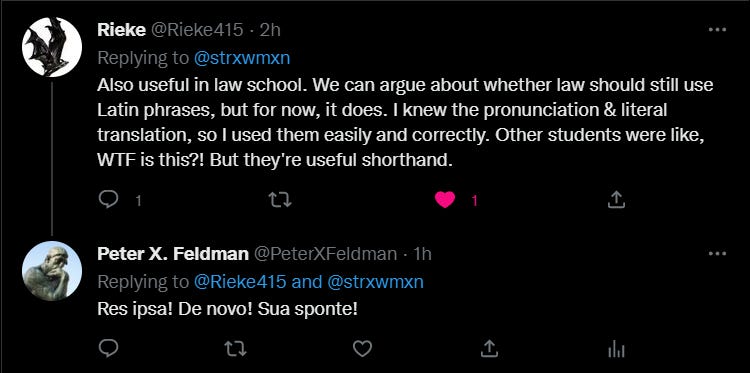
Give me a follow and tell me how stupid I am. I could use it.
Thanks for indulging this overly-long introduction to who I am and what The Intersection is. I hope you enjoy your time here. I look forward to speaking with you soon.
I have many questions.